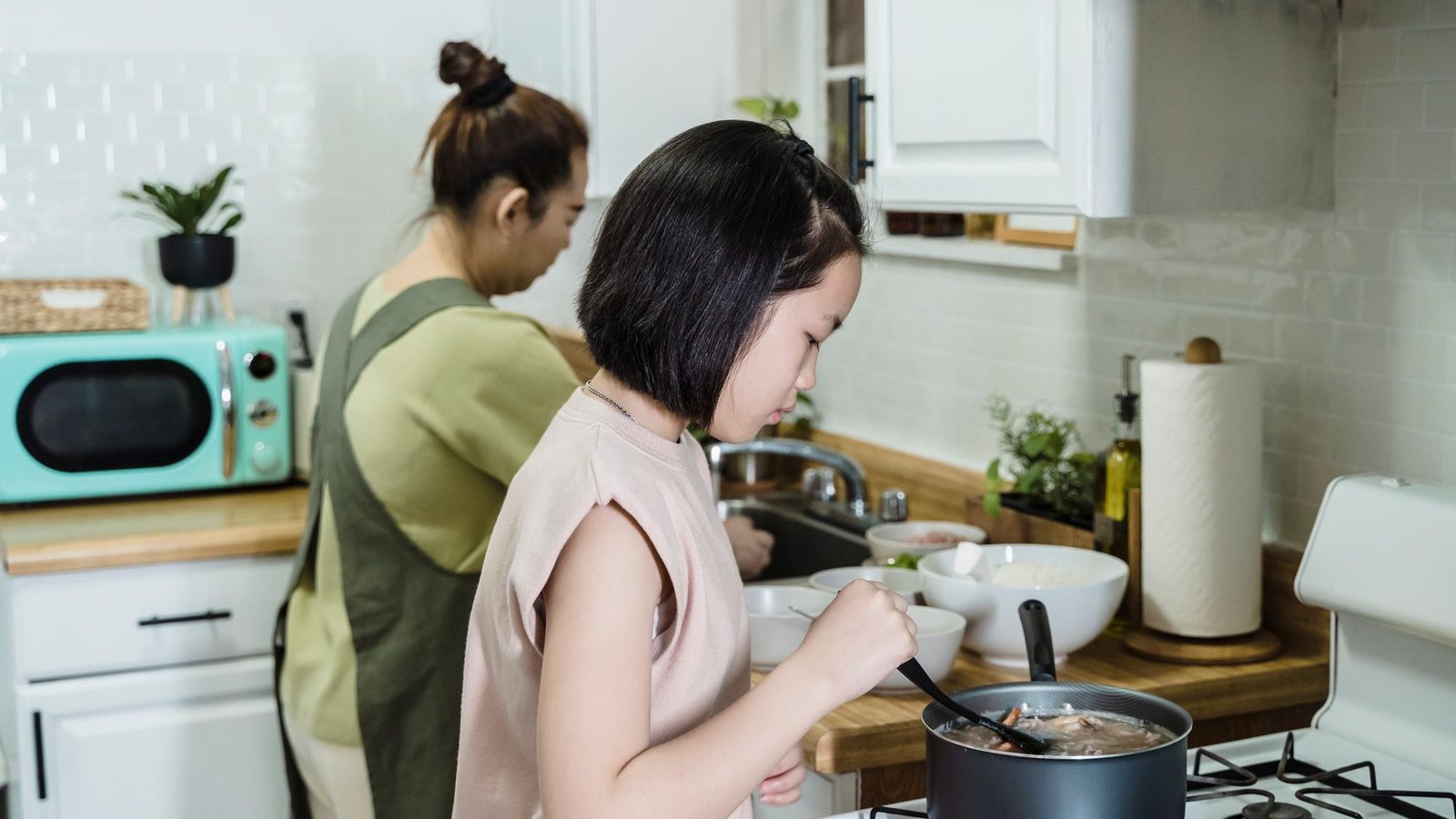
Adaptive skills are the everyday skills a person uses to take care of themselves and get through the day. Getting dressed, eating, using the toilet, staying safe, handling money, getting around and getting along with people are all adaptive skills. They're learned, like reading, so they can be taught at any age.
In autistic kids, these skills often trail far behind how smart the child is. They also shape how much a person can do on their own as an adult. No wonder the term keeps turning up on reports and plans.
What are some examples of adaptive skills?
Examples of adaptive skills change as a person grows, because the jobs in a normal day change. Here's what families most often work on at each age. Treat it as a set of examples, not a test: plenty of people learn these in a different order.
| Age | Adaptive skills families often work on |
|---|---|
| 3 to 5 | Washing hands, using the toilet, eating with a spoon, taking turns, asking for help, staying close in a store |
| 6 to 12 | Getting dressed, brushing teeth well, making a snack, joining a game, following a morning routine, crossing a quiet street |
| 13 to 17 | Showering, using deodorant, cooking a simple meal, ordering food, paying at a store, getting to a friend's house |
| 18 and up | Cooking, laundry, taking medicine on time, paying bills, riding the bus, making appointments, small talk at work |
A skill only counts once the person does it on their own, on a normal day, in the place it's needed. Doing it once while someone talks them through each step doesn't count yet.
That's how a child can know how to get dressed and still need you there every single morning.
What are the three types of adaptive skills?
Professionals sort adaptive skills into three types: practical, social and conceptual. The groups come from the American Association on Intellectual and Developmental Disabilities.
- Practical. Looking after your body and your home: dressing, bathing, meals, chores, health, safety and getting from place to place.
- Social. Getting along with people: friendships, following rules, working out problems, and noticing when someone is taking advantage of you.
- Conceptual. Using words, numbers, money and time to run your own life: reading a schedule, telling time, counting change, planning what comes next.
Reports don't always use those three names. You might see daily living skills, socialization and communication instead. They're the same skills, grouped a little differently.
How are adaptive skills measured?
Adaptive skills are measured by asking the people who know someone best what that person does alone on a typical day. A parent, a teacher or the person themselves answers a long list of questions, on a form or in an interview. Two you'll often see named on reports are the Vineland and the ABAS.
Every question asks the same thing: does the person do this without help, most of the time? A child who brushes well only while you stand there and name each step gets scored as needing help. The test is right about that. On a normal morning, they still need you.
Most reports score adaptive skills on a scale where 100 is average. About two in three people score between 85 and 115. A score of 70 or below means a big gap: only about 2 in 100 people that age score that low.
A low score is a snapshot of today, not a ceiling. It doesn't measure how smart someone is. Read it as a list of what to teach next.
Why do bright autistic kids fall behind on adaptive skills?
Because knowing how to do something and doing it alone are two different skills. Being smart helps with knowing how. Autism often makes doing it alone much harder.
A 2019 study of 2,225 autistic children and teens in Western Australia showed how big that gap can be. In kids without an intellectual disability, everyday skills scored 28 points below IQ on average. In kids with one, the gap was less than 5 points. The gap stayed large in kids diagnosed at older ages, too. The researchers said the label "high functioning" should be dropped, because IQ said so little about how kids got through a day.
We see the same split at 7 and at 37. Someone can explain every step of a shower, a bus trip or a grocery run. Then they stand at the start, waiting for someone to say go. A shower is a long chain of small steps, and nobody in the bathroom says "next."
How are adaptive skills taught?
Teach one skill at a time, in small steps, at the time and place the skill really happens. These steps come from methods that a 2020 review of 972 studies found work for autistic children, teens and young adults.
- Pick one skill that comes up every day. A daily skill gets practiced about 30 times a month without anyone planning it.
- Write the steps down in order, each one small enough to be a single move. For a shirt: hold it up, find the tag, head through, one arm, then the other.
- Practice at the real time, in the real place. Shoes get taught at the front door, not at the kitchen table.
- Wait five seconds before you help. Then give the smallest help that works: a point before words, and words before hands.
- Hand over the last step first. Once they finish the last step alone, hand over the last two.
- Take it on the road. When it works at home, try the same steps at a relative's house, the store or the bus stop.
Build each skill around something your child already loves. A favorite song can time the toothbrushing. A favorite show can be what's waiting once the dishes are done.
How do you get adaptive skills taught at home?
In California, ask your Regional Center for adaptive skills training. It's the service that sends a professional to your home to teach these skills, one at a time. The Regional Center is the state-funded agency that serves people with developmental disabilities like autism, and it pays for the training.
You can run the steps above yourself, and plenty of parents do. It takes the same steps, the same words and the same five-second wait. Every day, from every adult in the house, for weeks on each skill.
Every day, from every adult, for weeks: that's the part a busy house struggles to hold steady. A caring professional can hold it with you. Ours have master's degrees and 9.3 years of experience on average. Yours would be matched to your child because they've already helped people stuck on the same skill. Your Regional Center pays, so your family pays $0. Answer three quick questions to see whether adaptive skills training fits.
To ask for it, email your service coordinator, the person at your Regional Center who plans your child's services. Copy us, so nothing gets lost:
To: [your service coordinator's email]
CC: team@aldera.org
Hi [their first name],
I'd like to add Aldera (formerly Levi Life Skills) for adaptive skills training to [your child's full name]'s service plan.
Thank you.
Can't find their email? Search your inbox for @nlacrc.org, @westsiderc.org or @elarc.org. Not a Regional Center client yet? Our eligibility guide shows where to start.
One of the biggest misconceptions parents have is that adding adaptive skills training will cost them IHSS or respite hours. It won't. IHSS, the county program that pays for care at home, can't be lowered because you get Regional Center services. The state told every county so in writing. Respite, the paid breaks your Regional Center gives families, doesn't drop because of it either.
Are adaptive skills the same as life skills?
Mostly, yes. Life skills and daily living skills are everyday names for the practical side of adaptive skills. A few other terms get mixed up with them too.
| You might hear | What it means | Next to adaptive skills |
|---|---|---|
| Life skills or daily living skills | Cooking, cleaning, self-care and money | The practical part |
| Adaptive behavior | The term evaluators use | The same thing |
| Functional skills | The term many schools use | Nearly the same thing |
| Social skills | Getting along with people | One of the three types |
| Executive function | Planning, getting started and switching tasks | A reason adaptive skills are hard, not one of them |
Questions parents actually ask
Can adaptive skills be taught, or is my child just wired this way?
They can be taught. Every adaptive skill is learned. Autistic people usually learn them best in small steps, in the place they'll use them, the same way every time.
Is it too late to teach adaptive skills to a teen or an adult?
No. There's no age when these skills stop being teachable. Teens and adults often want them more, because the payoff is privacy, a paycheck or a night out without a parent.
What does a low adaptive behavior score mean?
It means the person does fewer everyday things on their own than most people their age, right now. It doesn't measure how smart they are, and it isn't a limit on what they can learn.
Does the Regional Center look at adaptive skills?
Yes. The Regional Center looks for a qualifying diagnosis and big gaps in three or more areas, like self-care, language or learning. That's why intake asks so much about your mornings.
Does getting adaptive skills training mean giving up IHSS or respite?
No. Both stay the same size when you add it. By state rule, the county figures IHSS hours with your Regional Center visits left out. Look at the letter.
Is adaptive skills training the same as ABA?
No. ABA is a therapy that changes behavior through practice and rewards, often for many hours a week. Adaptive skills training teaches the everyday skills on this page, at home, for $0 through your Regional Center. Our ABA vs adaptive skills training comparison goes deeper.