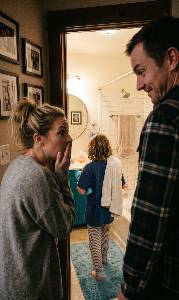
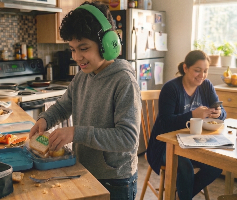
ABA works on behavior. Adaptive skills training works on the parts of the day you still run for your child. The shower you start. The clothes you lay out. The lunch you make. The bus stop you walk them to. If your child can do a lot but every routine still needs you standing there, adaptive skills training is built for that. Asking for it takes one email, and your child can have it alongside ABA.
ABA (applied behavior analysis) is a therapy that changes behavior through practice and rewards. Adaptive skills training is a service from your Regional Center, the California agency that serves people with developmental disabilities like autism. It teaches the skills of daily life, at home and around town.
| ABA | Adaptive skills training | |
|---|---|---|
| What your child works on | Behavior that gets in the way, and in big programs, talking and play | Daily life: dressing, washing up, cooking, money, getting around |
| Who comes | Mostly a behavior technician, whose credential takes 40 hours of training | A trainer with a bachelor's or master's degree |
| Where | A clinic, a school or your home | Your home, then the store, the bus stop or the park |
| Hours a week | 10 to 25 for a few goals, 30 to 40 for a full program | Set by your Regional Center after an assessment at home |
| Getting started | A doctor's or psychologist's OK, an agency with an opening, then your health plan's approval | One email to your service coordinator, then your Regional Center's approval |
| Ages | Any age, but Medi-Cal pays only until 21 | 3 and up, with no upper limit |
| What you pay | Copays and deductibles can apply, unless you have Medi-Cal | $0 |
What will your child actually work on?
In ABA, behavior comes first. A behavior analyst looks at what happens right before and right after a meltdown, a hit or a run for the door. Then the program teaches something to do instead. A full program adds talking and play, usually for young children. The field's own guidelines put it at 30 to 40 hours a week. That's a full-time job's worth of hours.
Adaptive skills training has one job: the skills a person needs to run their own day. Showering without a reminder. Getting dressed and out the door. Making lunch. Paying at the register and counting the change. Getting to the bus stop and back.
Being smart doesn't bring those skills along. In a study of 417 autistic teens with average or higher IQ, about half had daily living skills below average. IQ did little to predict which teens would struggle.
A lot of the teens we teach can recite the whole bus route. They have never ridden it alone.
Who comes to your house?
Ask about the person before you ask about the service. They'll be in your home every week, and your child has to want to work with them.
In most ABA programs, a behavior technician runs the weekly hours. The national credential for that job asks for a high school education, 40 hours of training and a test. A behavior analyst with a master's degree writes the plan and checks in on it.
Adaptive skills training starts higher. California lets only trainers with a bachelor's or master's degree provide it.
Before you sign with any agency, ask three things. Who exactly will come? Will it be the same person every time? Have they helped people who get stuck where your child does? With us, it's the same professional at every visit, matched to your child's interests and personality.
Will the skills show up at home?
Skills taught at home are the ones most likely to show up there. Adaptive skills training happens where the skill gets used: your kitchen, your bathroom, then the grocery store and the bus stop. ABA can happen at home too, or at a clinic or a school.
A skill learned in one room doesn't always leave it. Behavior researchers wrote about this back in 1977. The first approach on their list had a blunt name: train and hope. Teach the skill in one place, then hope it shows up somewhere else.
Parents of kids in clinic programs tell us the same thing, almost word for word.
"They do it there. They won't do it for me."
So adaptive skills training starts in your house, inside the real routine. Once it works there, practice moves out to the store or the park.
How hard is it to get ABA or adaptive skills training?
Adaptive skills training takes fewer steps to get. In California, the two paths look like this.
Getting ABA
- A doctor or psychologist recommends it. Private insurance usually wants an autism diagnosis too.
- You find an ABA agency in your health plan's network that has an opening.
- The agency's behavior analyst assesses your child and writes a plan.
- Your health plan approves the hours.
- Sessions start. By state law, the plan gets reviewed again at least every six months.
With private insurance, copays and deductibles can apply. Medi-Cal, California's public health coverage, pays for ABA only until age 21.
Getting adaptive skills training
- Email your service coordinator, the person at your Regional Center who manages your child's plan. Ask for adaptive skills training by name.
- Your Regional Center has 30 days to meet with you about adding it.
- The provider assesses your child at home, and your Regional Center sets the hours.
- Sessions start. With us, there's no waitlist.
Your family pays $0. Our guide to asking your Regional Center for adaptive skills training has the exact email, three lines long.
Can your child have both ABA and adaptive skills training?
Yes, as long as each one works on different goals. Plenty of families have both, and you don't have to drop ABA to add adaptive skills training.
Your Regional Center won't pay twice for the same goal. So when you ask, say what ABA covers and what nobody is teaching yet: "ABA is working on hitting. Nobody is teaching them to shower or make lunch."
One of the biggest misconceptions parents have is that adaptive skills training will cost them IHSS or respite hours. It won't. IHSS (In-Home Supportive Services) is the county program that pays someone, often a parent, to help with care at home. Respite pays a worker to watch your child so you get a break. Adding adaptive skills training won't lower either one. For IHSS, the state told every county in writing to set the hours as if your Regional Center services didn't exist.
Once both are running, tell each team what the other is working on. Use the same words for the same step, from every adult. That's how a skill learned with one person starts showing up for everyone.
How to choose between ABA and adaptive skills training
Start from what's hard at home.
- Knows it, can't run it. Your child knows the steps of a routine but waits for you to say go. That's the job adaptive skills training does.
- Teens and adults. Adaptive skills training has no upper age limit, and Medi-Cal stops paying for ABA at 21.
- ABA is already running. If the routines at home still fall to you, add adaptive skills training with different goals.
- Waiting on ABA. You don't need ABA first to ask for adaptive skills training.
That first case wears parents down the most. Your child knows every step of getting ready and still waits for your voice. So you teach the same morning again, every morning, on top of everything else.
Hand that morning to someone else for a while. Every professional we send is caring, holds a master's degree, and brings 9.3 years of experience on average. Yours would be matched to your child because they've already helped people who wait at that same step. It's $0 to your family, through your Regional Center. See if adaptive skills training could take the morning off your list.
Questions parents actually ask
Is adaptive skills training just ABA under another name?
No. ABA is a method built around behavior. Adaptive skills training is a Regional Center service built around daily life. Good trainers use some of the same proven teaching, like breaking a skill into small steps. The goal, though, is always something your child does at home or in town.
What if my child won't work with a stranger?
Then the match matters more than the method. Ask how the provider picks the person, and whether it's the same one every time. A skill built around something your child already loves goes down a lot easier.
Could adaptive skills training cut our IHSS or respite hours?
No. It won't cut your IHSS hours, and it won't cut your respite. The state told each county to count IHSS hours without your Regional Center help. Read the state's letter.
Is ABA harmful?
It's debated. Some autistic adults say the ABA they had as kids hurt them, and others say it helped. Whatever you choose, watch a session first and ask what happens when your child says no.
Does my child need an autism diagnosis for either one?
For ABA through private insurance, usually yes. Adaptive skills training needs your child to be a Regional Center client, which covers autism and some other developmental disabilities. Our eligibility check shows where to start.
My child is an adult now. Is it too late?
No. Adaptive skills training has no upper age limit. Grown children work on cooking dinner, paying bills, taking the bus and handling their own doctor visits.