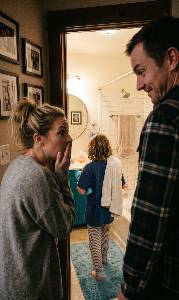
It's 6:40 in the morning and you're sitting on the edge of the bathtub, reading the same book out loud for the ninth time this week. Your kid is on the toilet. Nothing is happening.
Four minutes after you give up, they pee on the hallway floor, two feet from the bathroom door.
You have a system for this now. You know which towels are the pee towels.
They're six. They can unlock your phone, find the app you moved and get themselves to level 40, and they cannot tell you they need to go.
So you've been waiting. Their pediatrician handed you the sentence, and then your mother handed you the same one.
"They'll do it when they're ready."
They're six. You've been ready since they were three.
For most kids that's fine advice. For a lot of autistic kids it's the reason they're still in a pull-up at seven. They're not refusing. They're waiting on a signal nobody taught them to read.
Here's what you're walking out with.
- The three days of notes to take before you change a thing.
- The schedule, including how long a sit should last. It's shorter than you think.
- The real timeline, including the week accidents go up instead of down.
- What to do when the poop stalls, because poop is its own project.
The laundry is the smallest part of this. A child who isn't toilet trained gets left out of the sleepover and the day camp, and every year this drags on they build a little more of a story about themselves out of it.
Stay to the end and you get the one sentence to stop saying tomorrow. Most parents say it ten times a day with the best intentions, and it teaches exactly the wrong thing.
Why "they'll do it when they're ready" stalls autistic kids
Readiness checklists were written for children who can feel a full bladder and say so. Staying dry for two hours, telling you the diaper is wet, minding it enough to complain, asking to use the toilet. Every one of those signs needs a body that sends a clear message and a child who can read it.
That reading skill has a name. Interoception is the sense that tells you what's happening inside your body, like hunger, thirst, or the two minutes of warning before you need a bathroom. For a lot of autistic children it shows up late and faint, and sometimes all at once with no warning at all.
So the wet pull-up doesn't bother them and the full bladder never announces itself. That's a missing skill sitting behind a sensory gap, and skills get taught.
Here's the pattern we see over and over. It isn't a test and it diagnoses nothing. It tells you whether the waiting is likely to end on its own.
- Stays dry for two hours or more and still never asks.
- Sits in a soaked pull-up without noticing, or notices and doesn't mind.
- Can name every step of the bathroom routine and still won't start step one.
- Goes to the same spot in the house to poop, standing up, in a pull-up.
- Is dry all day at school and wet all afternoon at home.
Standard potty training runs on a fire alarm. The bladder fills, the alarm goes off, the child runs. That plan needs an alarm that works.
When the alarm isn't wired yet, you don't sit and wait for it.
You run a bus.
A bus doesn't care whether anyone is standing at the stop. It shows up at 9:00, then 10:00, then 11:00, and riders learn the schedule by riding it.
Put the bathroom on a schedule, not on a signal
Run the trips on a clock for the first several weeks and let the signal catch up later. Your child doesn't have to know they need to go. They have to be sitting on the toilet when their body was going to go anyway, and after enough of those their body connects the feeling to the room.
Take three days of notes before you change anything
Check the pull-up every 30 minutes for three days and write down the time and whether it's wet or dry, marking poops separately. Change nothing else yet. Most parents see the shape by day two: the twenty minutes after a big drink, the hour after breakfast, the 3:00 crash after school.
Set the interval from your own notes, then set a real alarm
Find the gap where your child is usually still dry and start the trips 15 minutes before the end of it, which for most families lands between 45 and 90 minutes. Start closer together than feels reasonable, because stretching the interval later is the easy part.
Keep the sit to three to five minutes
The most common mistake we walk into is the twenty-minute sit. Nothing happens, nobody wants to waste the trip, so everyone waits. By minute twenty you have two people stuck in a bathroom, and one of them is on a phone.
Long sits teach a child that the toilet is where fun stops. Short sits stay cheap enough to run a lot of them, and volume is what teaches this skill.
One more thing, and it's what most reward charts get backward: pay for the sitting, not only for the result. A child who can't feel the urge has no control over whether anything happens, but they do control walking in and sitting down. Whatever the reward is, it lives in the bathroom and nowhere else. In a lot of the homes we work in there's now a bag of M&Ms parked on top of the toilet tank, and it belongs to no one. It belongs to the toilet.
That's the notes and the schedule, two of the four.
How long potty training takes for an autistic child
Six to twelve weeks for daytime pee, for most of the children in our programs. Poop usually lands weeks or months after that, and night training is a separate project that can come years later.
Week one usually gets worse. Accidents go up rather than down, because you just took away the pull-up that was quietly handling the problem. Most families who quit, quit right here, four days in.
Day four is easier to get through next to someone who has watched week one turn around. We'd send a caring professional with a master's degree and 9.3 years of experience on average. They're matched to your child because they've already helped kids through this exact week. Through your Regional Center, it costs you $0. If that would change how week one goes, check whether your child is a match for adaptive skills training.
Week two is where the first real catch shows up and something lands in the toilet on purpose. You will feel a level of joy about this that would embarrass you in front of anyone who doesn't have a kid.
Weeks three through six are where the interval stretches, from 60 minutes to 75, then 90. Stretch after four or five dry days in a row, 15 minutes at a time.
Somewhere in there you get a bad week for no reason at all. A cold, or a substitute teacher, or a week at grandma's. Sliding backward is part of the shape, so drop to the shorter interval for a week and stretch again.
Now the part that surprises most parents. The children who get there fastest are usually not the ones with the most words.
The skill on the table here is timing. We work with children who don't speak at all and who train on the same schedule as everyone else, because the schedule never asked them to say anything. What they need is one way to ask, for the day they start asking: one card, one sign, one button, used the same way everywhere.
Stepping back is the same move as coaching a child through park play. You stand close and run it for them, then stand a little further back each week.
Why your child will pee in the toilet and still hold the poop
Because pooping asks for something peeing doesn't. Your child has to relax on purpose, in a room they're still learning, on somebody else's schedule.
There's usually a second reason, and it's the one parents miss. Somewhere in the last year or two, one poop hurt. After that the body draws a straight line from pushing to pain and starts holding, and holding makes the next one harder and drier.
A child who holds their poop usually isn't being difficult. They're being careful. Somewhere back there, this hurt.
Once the medical side is handled, the move that works starts by giving up the fight you want to win. Every family has a spot: behind the couch, the corner of the pantry, one specific rug that everyone in the house has feelings about. Your kid asks for the pull-up, walks to the spot, and stands there.
Let them have the pull-up. Move the location instead, one small step at a time, and stay on each step until it's boring.
- Pull-up on, in their usual spot. That's where you start, on purpose.
- Pull-up on, standing inside the bathroom with the door open.
- Pull-up on, standing right next to the toilet.
- Pull-up on, sitting on the closed toilet lid.
- Pull-up on, sitting on the open toilet seat.
- Pull-up with a hole cut in the bottom, sitting on the toilet.
- No pull-up.
That second-to-last step sounds ridiculous and it's the one families remember. It works because the pull-up is still there doing its job as a familiar object while the poop quietly starts going somewhere new. Some children move up a step a week and some sit on one for a month, and pushing the pace is the fastest way to go backward.
That's three of the four.
Public bathrooms, school, and the toilet that flushes itself
One public bathroom can undo six weeks of work, and the usual culprit is the toilet that flushes by itself. The sensor reads a shift in the light, fires while your child is still sitting there, and does it at a volume that would move furniture.
The fix costs about a dollar. Keep a pad of sticky notes in the car, cover the sensor before your child sits down, and peel it off on the way out.
School runs on the school's clock, in a different stall, with an audience. Ask for one thing in writing: have the aide run your interval, at the same clock times, in the same words you use at home. A child learning this can handle a new bathroom or a new script, and both at once is where it falls apart.
The bus route has to run in more than one neighborhood, so add bathrooms on purpose while things are going well. Don't let a road trip be the first time you find out.
When to stop running this alone
Bring in help when the schedule has run the same way for six weeks and the numbers haven't moved. Before that, the answer is almost always to keep going and shorten the interval.
- Six weeks of a consistent schedule and the accident count is flat.
- The poop hasn't moved at all, and a doctor has already ruled out constipation.
- The bathroom has turned into a fight, and now your child cries at the door.
- School can't run the schedule, and it can't be run from home alone.
- You've started three plans this year and stopped all three, because you're running on empty.
That last one is a real reason and it's the one parents apologize for. Don't. Consistency is the active ingredient here, and no exhausted person is consistent for eight weeks straight.
What a specialist does about it is unglamorous. We come to your house, watch one real trip at your real bathroom door, and set the interval off your notes instead of a general rule. Then we teach every adult in the house to run it the same way, in the same words, including the grandmother who thinks the whole thing is silly. Getting adults to match each other is most of the work, and it's nearly impossible to hold together from inside a family.
What that gets your child is a bathroom they can use at a friend's house, with nobody standing outside the door.
Your Regional Center funds that work, so your family pays $0. If the six weeks have come and gone, see what adaptive skills training would look like for your child.
Questions parents actually ask
What age should we start?
Most families we work with start between four and eight, and age isn't the gate. If your child can walk to a bathroom and sit for three minutes, they're old enough to start the schedule.
Is it too late? My kid is nine.
No. Older children often move faster than their parents expect once the schedule is genuinely consistent, because they already hold routines well. The plan barely changes with age. The rewards do.
My child doesn't talk. Can they still be toilet trained?
Yes. The clock runs the trips, so nothing in the plan requires your child to say a word. Give them one way to ask for the day they start asking.
Pull-ups or underwear during the day?
Underwear during the day once you start, pull-up for sleep, because a daytime pull-up does the job your child's body needs to learn to do. The exception is the poop plan above, where the pull-up is a tool you fade on purpose.
My kid is dry at school and wet at home. Why?
Because school runs on a schedule and home runs on requests. School takes the whole class at 10:15 whether anyone asked or not, which is exactly the method in this article.
How should I react to an accident?
Flat and boring. One short sentence, hand your kid the wipes, have them help clean up, move on. A big reaction is still a reaction, and for some children that's worth more than a sticker.
Isn't rewarding my kid for this just bribery?
Fair question. A bribe is what you offer after a refusal to make it stop, and this is paid for work your child couldn't do on their own last month. It also fades once the routine gets boring, which bribes never do.
Here's the sentence. Stop asking "do you need to go potty?"
It's a kind question and it fails twice. It asks your child to read a signal they can't read yet, and it's a yes-or-no question, which hands them an easy no while they're in the middle of something better.
Say the other thing instead. "It's 10 o'clock. Bathroom time." Then walk with them, with no question and no negotiation about whether the bus is coming.
The bus is coming. That's the entire point of a bus.
You'll still find the towels, and there'll still be a hallway floor week somewhere in month two. But in a lot of the houses we walk into, something quiet happens around week six: the alarm goes off and your kid is already up and moving. They beat the bus to the stop.
If the schedule has been running for weeks and nothing has moved, that's the point where an extra set of hands in your actual bathroom is worth more than another article. If it is moving, leave it alone and let it stay boring.
Boring is what winning looks like here. Set the alarm for 9:00.