You do not notice how much of it you do until you try to count.
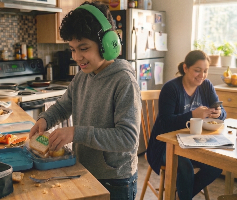
You lay the clothes out. You start the shower and check the water. You cut the food up without being asked, because you know how it goes when you do not.
You make the phone call. It takes two minutes, you have made it a hundred times, and every time you think next time they will make it.
You stand in the doorway and say the next step out loud. Then the next one. Then the one after that.
Nobody has ever offered you help with this part.
Everybody else who works with your kid has a lane. The doctor has the diagnosis. Speech has the words. School, or the day program, has the middle of the day. The lane nobody owns is where your kid actually lives. Getting dressed. Eating. Money. Being alone in the house without something going wrong.
Somewhere in a report you were handed there is a phrase for this. Adaptive functioning. A number sits next to it. Nobody told you what it meant.
So you do it yourself. At night. After work. With no plan, because there is nobody to hand it to.
And the part that makes you feel like you are losing your mind is that they are capable. Every family we work with has one of these. The thing your kid is unreasonably good at, three feet from the thing they cannot start.
Some part of you still hopes they will figure it out when they have to.
They have not. The list has not gotten shorter. It has gotten quieter.
If your kid is eight, the list looks like parenting. If your kid is twenty-eight, it looks like something else. Same list. You just stopped calling it help.
And somewhere in there you started doing math on who does this when you cannot.
The help for that list has a name, and asking for it takes one email. By the end of this you will have:
- The name to ask for, and the one sentence that asks for it.
- Who to send it to, and how to find their email in thirty seconds.
- What happens after you hit send, and how long your Regional Center has to answer.
- What to do if the answer is slow, or no.
The email itself is at the very end. Three lines, thirty seconds, and nothing you have to dig out of a folder first.
What do you ask for, exactly?
Ask for adaptive skills training, by that name. It is the Regional Center's term for one-on-one teaching of everyday skills in your own home: dressing, cooking, money, buses, staying home alone. Our page on adaptive skills training lists the skills it covers and what a session looks like.
The name matters more than it should. "We need help with daily living" starts a conversation. "I'd like to add adaptive skills training" is a request somebody can write into a plan.
Name the provider in the same sentence, and copy the provider on the email. Then the provider sees your request the same day your service coordinator does.
That is the first thing promised. Now the quick part, which you can do tonight: find your service coordinator's email. The next section shows the fastest way.
Who do you send the request to?
Send it to your service coordinator, the person at your Regional Center who manages your kid's plan.
The fastest way to find their email is your own inbox. Search for your Regional Center's address, like @nlacrc.org, @westsiderc.org, or @elarc.org, and any email from your service coordinator will have it.
Nothing there? Call your Regional Center's main number and ask who your service coordinator is. For the North Los Angeles County, Westside and Eastern Los Angeles Regional Centers, our guides say who to ask for.
Send the request by email. An email has a date on it, and that date starts a clock.
Being smart and being able to run your own day are two different skills. Everybody keeps score of the first one.
That gap is why the most capable-looking people get offered the least help. Every year we start programs with people who can explain the whole task and cannot begin it. Some are eight. Some are thirty-eight.
Either way, the person we send is a caring professional with a master's degree and 9.3 years of experience on average. We match them to your kid because they have already helped people who know every step and cannot start the first one. The cost to your family is $0, because your Regional Center pays it. Before you write the email, see if adaptive skills training is the right ask for your kid.
Do you have to wait for your annual IPP meeting?
No. You can ask for an IPP review at any time, and your Regional Center has 30 days from your request to hold it. When the need is urgent for health or safety, or to keep someone living at home, the deadline is 7 days.
That is the clock your email starts. Most families think the annual meeting is the only door. It is just the one everybody knows about.
What happens after you send the email?
Your request goes into your kid's plan first, and nothing gets paid for until it is there. Here is the order.
| Step | Who | How long |
|---|---|---|
| You email the request, provider copied | You | Tonight |
| Adaptive skills training added to the plan | Your Regional Center | Within 30 days of your request |
| An assessment at home | The provider | Once it is approved |
| First session | The provider | With us, no waitlist |
Keep every date in writing. Reply on the same email thread each time, so the whole history sits in one place.
What if the answer is slow, or no?
If 30 days pass with no review, reply to your first email. Quote the date you sent it and ask when the review is scheduled. A reply with a date in it is harder to lose than a voicemail.
If the answer is no, ask for it in writing, with the reason. You have 60 days to appeal, and Disability Rights California helps families with Regional Center appeals for free.
Questions parents actually ask
Can I choose which provider we get?
Yes. Name the provider in your email and copy them on it. For us, that address is team@aldera.org.
Is my kid too old for this?
No. There is no upper age limit, and it is the question we hear most from families of adults. Adult programs have the most ground to cover: cooking, buses, money, living with somebody who is not you.
How many hours should I ask for?
You don't have to name a number. The assessment usually settles it, and the hours get written into your kid's plan.
Is this the same thing as ABA?
No. Behavior services go after behavior that is getting in the way. Adaptive skills training goes after the skill itself, where it gets used. Plenty of families have both, as long as each one works on different goals. Our ABA vs adaptive skills training comparison shows how the two fit together.
Is this just babysitting?
Fair, and worth checking. Ask to see the written plan, the named skills, and last month's notes on what changed. If nobody can show you those, what you have is respite. Useful, but different.
My kid is not a Regional Center client yet.
Then eligibility comes first. It runs on a qualifying developmental disability and an evaluation, separate from any service. Our eligibility page covers where to start.
The list will still be there tomorrow. That part does not change on a Tuesday.
What changes is how long it stays yours, and that comes down to whether anybody asks. If you have a service coordinator, this is one email.
It needs your kid's full name and nothing else. No ID numbers, no codes, nothing to dig out of a folder.
To: [your service coordinator's email]
CC: team@aldera.org
Hi [their first name],
I'd like to add Aldera (formerly Levi Life Skills) for adaptive skills training to [your kid's full name]'s service plan.
Thank you.
For a different provider, swap in their name and copy them instead.
Send it and it is out of your hands, which is a better place for it than 11pm and your own head. If you want the first month from our end, how it works covers it.
You have been the whole program for years. No training, no plan, no relief, and a list you never agreed to keep. Nobody ever told you that you were allowed to hand part of it back.