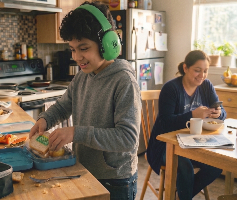
The ten minutes in the parked car before you go back inside.
The shower you cry in, because it's the only room with a lock.
The text from a friend asking how you are, still unanswered, because the true answer would take an hour.
The snap over something small, like the wrong cup or the wrong sock. Your kid is fine five minutes later. You aren't fine for the rest of the day.
There's a calendar on the fridge in three colors of marker. Every color is you.
You know the medicine doses and the date of the next school meeting by heart. You can't remember the last time you saw a doctor for yourself.
Your kid might be six or twenty-six. Either way, you're still the alarm clock, the cook, the ride and the one who remembers everything.
Three things, in the order you'll use them:
- The four signs that tell burnout from a bad week.
- The three loads to hand off first, and who can take each one.
- The one email that adds help at home for $0, word for word.
This matters because burnout doesn't wear off on its own. It eases when someone takes a piece of the load.
And at the very end, what to say the next time someone tells you they don't know how you do it. It turns the compliment into real help.
Is it autism parent burnout or just a bad week?
Burnout outlasts a bad week. A bad week lifts when the week ends. Burnout is still there after the good weekend and the full night's sleep.
It's there on the day your kid did great, too.
Researchers measure it with four signs, from a tool called the Parental Burnout Assessment. In plain words:
- You're worn out by being a parent, in a way sleep doesn't touch.
- You feel like you're no longer the parent you used to be.
- You're fed up with the parent job itself, even on calm days.
- You go through the motions with your kid and feel far away, even sitting right next to them.
The more of these fit, and the longer they've lasted, the more likely it's burnout. The list helps you see a pattern. It can't diagnose anything, and burnout can overlap with depression, which your own doctor can check.
Think about any job that runs day and night. Hospitals plan for it. Every nurse hands off to the next one at the end of a shift, and nobody calls that weakness.
Your house runs day and night too. Nobody comes in to take the next shift. Nobody brings donuts, either.
Before anyone does, you can drop something tonight. A short-staffed hospital floor triages: the must-dos get done, and the rest waits. Pick one job that keeps the house looking fine, rather than keeping your kid fine, and stop doing it for two weeks.
Paper plates count. So does cereal for dinner on a Tuesday. The clean laundry can live in the basket. It doesn't mind.
That's the first fix, and the research behind it is simple. Researchers who study parental burnout trace it to one imbalance. The demands on a parent outweigh the help they have, for a long time. So there are two ways out: take some weight off, or add hands.
Parents of autistic kids start out carrying more. A 2013 review of the research found they report far more parenting stress than parents of kids without a disability. Duh.
Those are the signs, the first of the three. The loads come next, heaviest first.
Hand off the daily routines first
Start with the daily routines, because they're the one load that comes back every single day. Getting dressed, the shower, teeth, meals, the morning rush and bedtime. For a younger kid it's shoes and a toothbrush. For an adult it might be laundry, a simple dinner and the bus.
The best handoff of all goes to your kid.
Every other handoff borrows someone's time and gives you back an afternoon. When your child learns to do a routine alone, that job leaves your list, and nobody has to pick it up.
The Regional Center, California's agency for people with autism and other developmental disabilities, has a name for this help: adaptive skills training. A professional comes to your home and teaches your child one routine at a time, in the room where it happens. Then they step back as your child takes over.
Teaching a routine takes the same steps in the same order, every day for weeks. That's the hardest thing to hold steady when you're the one running on empty.
Holding that steady, every day, is the shift to hand over. The person who'd take it is a caring professional with a master's degree and 9.3 years of experience on average. They'd be matched to your child because they've already helped people learn the same routines. Through your Regional Center, your family pays $0. Find out if adaptive skills training could take that shift.
What your child gets is a routine that's theirs. What you get is one less shift.
Then hand off some of the watching
The watching is the second load to hand off. It's every hour you can't leave the room or shower in peace.
Respite is the help built for this. Your Regional Center can pay a worker to take over for a few hours so you get a break. The worker can even be someone you already trust, like a grandparent or a friend. Our guide to Regional Center respite covers the hours families get and how to ask.
Those hours do more than they seem to. In a 2013 study of 101 couples raising autistic children, more respite went with less daily stress. Even one extra hour a week went with a better marriage. Cheaper than couples counseling, too.
Plenty of parents hold off on adding anything new, afraid it will cost them hours they fought hard to get. That's one of the biggest misconceptions we hear, and it's wrong. Adding adaptive skills training won't lower your respite. It won't lower IHSS (In-Home Supportive Services) either, the county program that pays for care at home. For IHSS, the state put it in writing: counties set the hours without counting anything the Regional Center pays for.
That's two of the three loads.
Split up the calls, emails and forms
Because your service coordinator already owns part of the calls and forms, they're the easiest load to split. Your service coordinator is the person at your Regional Center who plans your child's services and gets them paid for. Setting up services is part of that job. When one stalls, email your service coordinator the problem in one line and let them make the calls.
The rest of the paperwork can go to one other adult. That might be a partner, a grandparent or the friend who keeps asking how to help. Give them a whole category, start to finish, like every school email or every prescription refill.
The wording matters. "Can you help with the school stuff?" still leaves you in charge of remembering it. "The school emails are yours now" takes it off your list.
That's all three loads. Here's the email we promised.
The one email that adds help at home for $0
One email does it: a single sentence to your service coordinator, asking to add adaptive skills training. When your Regional Center approves it, your family pays $0. There's no insurance billing and no waitlist.
All it takes is your child's full name, which you can probably write faster than your own by now. Copy this, fill in the brackets and send it:
To: [your service coordinator's email]
CC: team@aldera.org
Hi [their first name],
I'd like to add Aldera (formerly Levi Life Skills) for adaptive skills training to [your child's full name]'s service plan.
Thank you.
Can't find the address? Search your inbox for @nlacrc.org, @westsiderc.org or @elarc.org, or for your own center's name.
Send it, and one load is already moving without you.
Questions parents actually ask
Is burnout the same as depression?
They can overlap, but burnout is tied to the parent job: you're worn out by parenting in particular. If everything feels heavy, everywhere, or the low mood won't lift, talk to your own doctor.
Does needing a break make me a bad parent?
No. It means the job is bigger than one person. Hospitals plan a shift change for exactly that reason.
Will adaptive skills training lower our IHSS or respite hours?
No. Adding it won't make IHSS or respite drop. The state sent every county a letter. It says Regional Center help can't count when IHSS hours get set. Read it.
Can I get paid for the care I already give?
Sometimes. If your child gets IHSS, the county program that pays for care at home, a parent can be the paid provider. Our guide to becoming an IHSS parent provider walks through it.
What if nobody in my life can take a shift?
Then the shifts go to people who are paid to take them. Respite can pay a worker, and adaptive skills training sends a professional to your home, both through your Regional Center.
What if my child isn't with a Regional Center yet?
Start there. Regional Centers serve Californians with autism and other developmental disabilities at any age, and our eligibility page shows the first step.
Now the answer we promised. The next time someone says, "I don't know how you do it," tell them the truth and hand them a shift.
"I don't, not alone. Could you take Thursday pickup for the next month?"
Most people who say it really would help. They just don't know what you need, and they don't want to guess wrong. Now they don't have to guess. The ones who didn't mean it will suddenly be busy on Thursdays.
The calendar on the fridge will be mostly your color for a while yet. One square in someone else's color is how a shift change starts. Ask for that square this week.
You were never supposed to be every color.